Tuesday, 15 July 2014

Wednesday, 2 July 2014
Director Study: Sophie Muller
Sophie Muller is a British music video director. She has had many collaborations with famous artists over her 32 years in the industry, such as Sophie Ellis-Bexter, The Killers, Blur, Leona Lewis and Annie Lenox. Muller is 52 years old and works solely as a music video director, having done no work in film or advertising, and has directed over 100 productions. Many have dubbed her as the most successful female music director of all time. I decided to analyse 2 of Muller's music videos from slightly different time periods - 1 from 2007 and 1 from 2013, from just 8 months ago.
MIKA - Grace Kelly
Firstly, I decided to analyse MIKA's music video, Grace Kelly, which was released in 2007 but filming commenced in November 2006. The video was nominated for numerous worldwide awards.
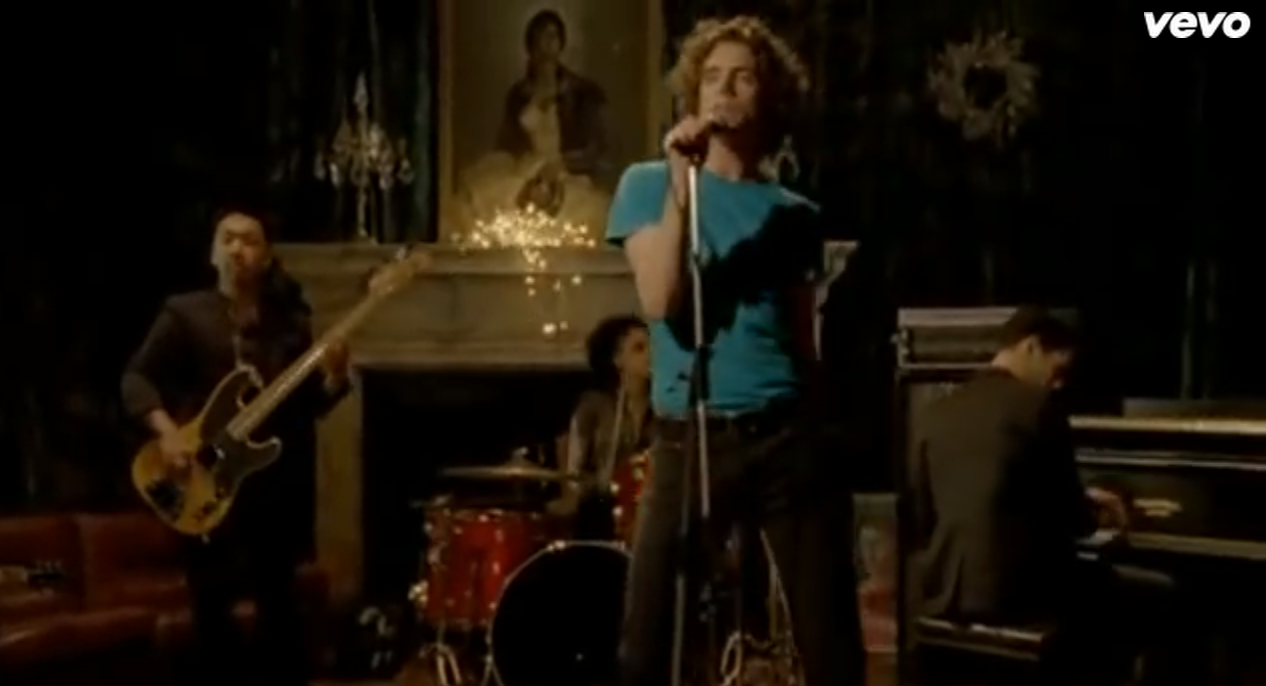 This music video would be categorised as a performance video and there are some elements that can be used to identify this. The most obvious, of course, is that there are shots of the artist performing the song. Therefore, it allows the audience to make a relationship between the person singing and the song itself, meaning that it becomes more clear who the song belongs to. In performance music videos, shots of the artist performing are essential.
Performance videos also may present the artist in real-life situations such as warming up, talking or simply fooling around. During the introduction to this video, MIKA is seen to be talking to a young girl before he starts performing. Although the words are lip-synched and do fit into the rhythm of the music, this shows MIKA being in a real life situation and so this characteristic of performance music videos can also be applied.

Finally, many close-ups of the artist are displayed throughout the music video. The reason for this is because these close-up shots help to promote the main star in the music video and consequently, this makes them more recognisable in the media. This will lead to a higher profile for the artist and so, eventually, will generate a higher revenue for the record label. These close-ups also give the audience a chance to see MIKA performing.
Goodwin's music video theory can also be applied to Grace Kelly. The theory consists of seven main codes and conventions that Goodwin believed many music videos had in common with each other, and many of these elements can be seen to be used by Muller in MIKA's music video.

Firstly, there is an evident relationship between the lyrics and the visuals in the music video. The main star of the video, MIKA, is quite clearly singing the song. This links back to the video possessing the characteristics of a performance music video. This link between the lyrics and the visuals makes the music video seem more relevant to the song.

Similarly, there is also a distinct relationship between the music and the visuals used in the music video. For example, in Grace Kelly, you see MIKA performing on the piano. This piano is also used in the song, making it appear as if MIKA is playing the song to the girl. Again, this relationship between the music and the visuals mean that the video seems relevant to the song and so the audience is more likely to enjoy it.
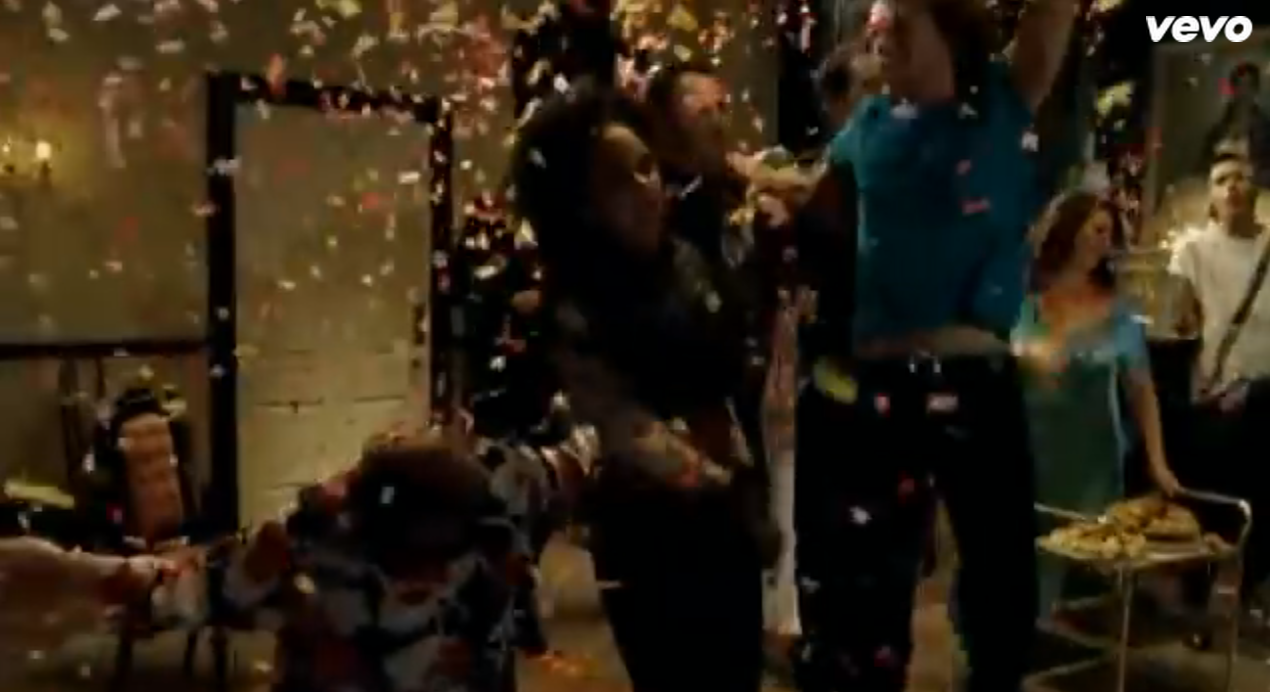 According to Goodwin, music videos should also demonstrate certain genre characteristics. Grace Kelly is a pop song and the music video is certainly reflective of this. In terms of mise-en-scene, very bright colours are used. There is multicoloured confetti as well as people dancing with MIKA, who is wearing blue (connotative of calmness and relaxation). The video also stars mainly young people because this attracts the main target audience of the pop genre - young people. This up-beat style is very typical of pop music videos.
 Finally, MIKA's Grace Kelly music video also follows a distinct visual style. For example, if you watch another MIKA music video, such as Love Today (which was released in the same album as Grace Kelly) you will notice that it follows a very similar style. For example, lots of people are seen to be wearing very bright colours and dancing together whilst the star is performing. A screenshot from Love Today can be seen on the left.
Overall, I absolutely love this music video. I really like the pop genre (and, being a young person, am part of the target audience) and I think that Muller did a great job at directing this video in order to entertain the audiences and help to reinforce the song lyrics through MIKA's unique performance style.
Robin Thicke - Feel Good
The second music video I have decided to analyse is American recording artist Robin Thicke's Feel Good. The music video was also directed by Sophie Muller. The song was released on 12th November 2013.
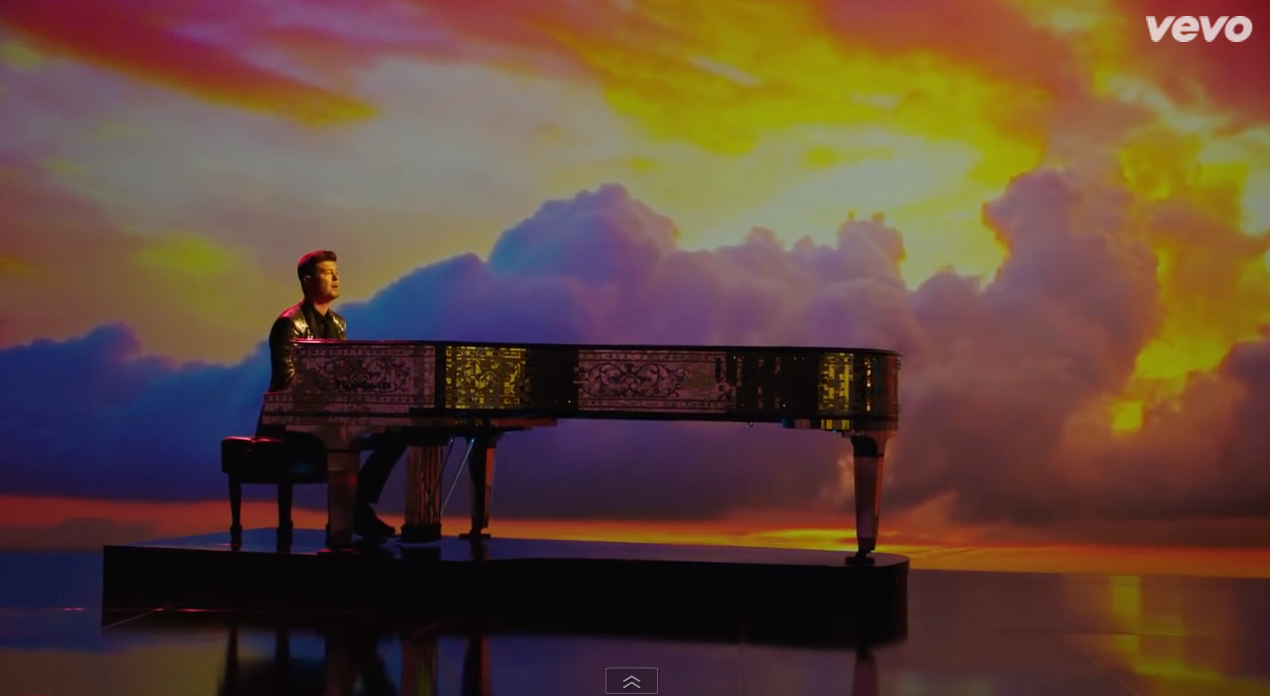 Similarly to Grace Kelly, I would categorise this as a performance music video. Robin Thicke - the main star and artist in the video - is seen to be singing the song and playing the music during the video. Again, this is done in order to allow for the audience to construct a relationship between the artist and the music, meaning that they are more likely to listen to other songs that belong to the same artist in the future, because they have prior knowledge of their genre.
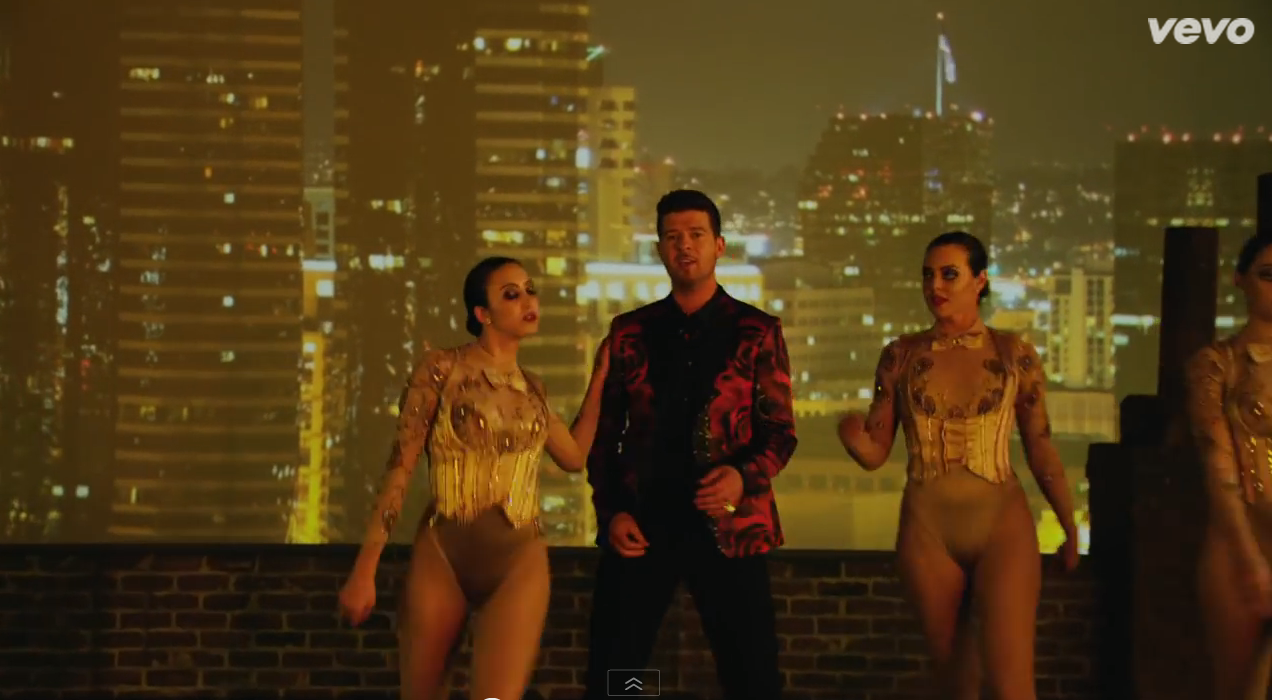 Something that Feel Good's music video contains that Grace Kelly's does not is shots of the artist performing in unusual places. In Feel Good, Robin Thicke can be seen to be performing with dancers on a roof top in a particularly urban location at night. This is another element of a performance music video and, although it is slightly different to MIKA's, still shows the artist performing.
 Additionally, the artist can be seen in a real-life situation. Near the end of the video, Robin Thicke can be seen sitting alone in a room drinking alcohol. Not only is this something that many of the target audience would enjoy doing, and so would be able to relate to it, but many musical artists are stereotypically people who enjoy getting drunk. Therefore, it also adheres to stereotypes of famous people.
Muller also appears to have adhered to some of the codes and conventions propounded by Goodwin in the Feel Good music video, some of which are more prominent than others.
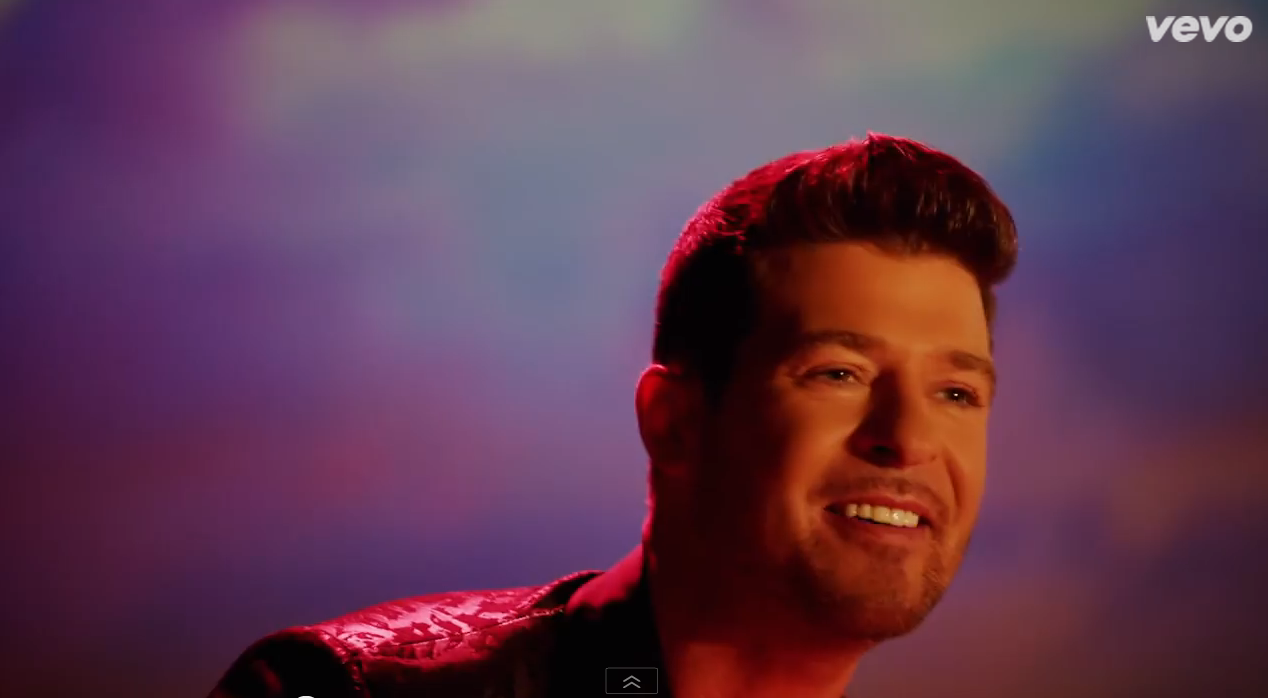 Firstly, the demands of the record label will include the need for lots of close-ups of the artist. There are various close-up shots of Robin Thicke singing and performing throughout this music video. This helps to give him a higher profile and therefore, will generate a larger sum of money in future endeavours with the record label as more people will be aware of him and want to buy his music.
 Also, there is a frequent notion to 'looking' and particularly voyeuristic treatment of the female body. In the video, there are absolutely no male dancers. All of the dancers are wearing pink, which is particularly stereotypical of females. The female dancers are wearing a small amount of clothing as not only does this encourages the male gaze and make more males want to watch the video, but it makes Robin Thicke look more manly and powerful.
 This also links into Robin Thicke's development of motifs and iconography that recurs across his work. Blurred Lines, another song released by Robin Thicke earlier in 2013, also had only female dancers that were treated in a very objectified manner. They wore almost no clothing and again, encouraged the male gaze. This has resulted in Robin Thicke developing a very controversial image of being a "ladies man", which in turn makes him more popular with his target audience.
Sophie Muller clearly does not have a distinct 'style' when she is directing her music videos. MIKA's music video is quite fun and up-beat, whereas Robin Thicke's is more raunchy and directed towards an older audience. However, saying that, both of Muller's videos that I have studied have been performance videos. This may suggest that many of Sophie Muller's music videos show the artist performing, perhaps because this makes them more well-known by the audience.
Overall, I am a fan of Sophie Muller's work. I think that she does a very good job at a creating music videos that are reflective of the song and that engages the audience and enhances the overall impact of the song. The performance aspects of the videos are also very entertaining and allows for the audience to develop more of a relationship with the artist. I am a big fan of Muller's work!
According to Goodwin, music videos should also demonstrate certain genre characteristics. Grace Kelly is a pop song and the music video is certainly reflective of this. In terms of mise-en-scene, very bright colours are used. There is multicoloured confetti as well as people dancing with MIKA, who is wearing blue (connotative of calmness and relaxation). The video also stars mainly young people because this attracts the main target audience of the pop genre - young people. This up-beat style is very typical of pop music videos.Overall, I absolutely love this music video. I really like the pop genre (and, being a young person, am part of the target audience) and I think that Muller did a great job at directing this video in order to entertain the audiences and help to reinforce the song lyrics through MIKA's unique performance style.
Robin Thicke - Feel Good
The second music video I have decided to analyse is American recording artist Robin Thicke's Feel Good. The music video was also directed by Sophie Muller. The song was released on 12th November 2013.
Similarly to Grace Kelly, I would categorise this as a performance music video. Robin Thicke - the main star and artist in the video - is seen to be singing the song and playing the music during the video. Again, this is done in order to allow for the audience to construct a relationship between the artist and the music, meaning that they are more likely to listen to other songs that belong to the same artist in the future, because they have prior knowledge of their genre.Something that Feel Good's music video contains that Grace Kelly's does not is shots of the artist performing in unusual places. In Feel Good, Robin Thicke can be seen to be performing with dancers on a roof top in a particularly urban location at night. This is another element of a performance music video and, although it is slightly different to MIKA's, still shows the artist performing.Muller also appears to have adhered to some of the codes and conventions propounded by Goodwin in the Feel Good music video, some of which are more prominent than others.
Firstly, the demands of the record label will include the need for lots of close-ups of the artist. There are various close-up shots of Robin Thicke singing and performing throughout this music video. This helps to give him a higher profile and therefore, will generate a larger sum of money in future endeavours with the record label as more people will be aware of him and want to buy his music.This also links into Robin Thicke's development of motifs and iconography that recurs across his work. Blurred Lines, another song released by Robin Thicke earlier in 2013, also had only female dancers that were treated in a very objectified manner. They wore almost no clothing and again, encouraged the male gaze. This has resulted in Robin Thicke developing a very controversial image of being a "ladies man", which in turn makes him more popular with his target audience.Sophie Muller clearly does not have a distinct 'style' when she is directing her music videos. MIKA's music video is quite fun and up-beat, whereas Robin Thicke's is more raunchy and directed towards an older audience. However, saying that, both of Muller's videos that I have studied have been performance videos. This may suggest that many of Sophie Muller's music videos show the artist performing, perhaps because this makes them more well-known by the audience.
Overall, I am a fan of Sophie Muller's work. I think that she does a very good job at a creating music videos that are reflective of the song and that engages the audience and enhances the overall impact of the song. The performance aspects of the videos are also very entertaining and allows for the audience to develop more of a relationship with the artist. I am a big fan of Muller's work!
Tuesday, 24 June 2014
Research: Representation of Age
I decided to look at how young people were represented in music videos. I focused specifically upon the music video We Found Love (by Rhianna ft. Calvin Harris), that showed a young couple.
In case the above embedment of my presentation is dysfunctional, it can also be found on an external link here.
Sunday, 22 June 2014
Research: Record Labels
There are four main types of Record Labels:
- Major record labels - dominate the market and consist of major distribution.
- Independent record labels - lack the ability of major distribution.
- Sub-labels and imprints - separate companies or divisions owned or distributed by the major labels.
- Speciality record labels - focus on non-mainstream material and use non-traditional distribution methods.
I have decided to research one major record label (Sony Music Entertainment) and one minor record label (Dualtone Records) in order to compare how they differ from each other.

Sony Music Entertainment (SME) is an American music corporation owned and operated by the Japanese conglomerate Sony Corporation. The enterprise was first founded in 1929 as the American Record Corporation. However, Sony Corporation of America brought the company in 1987 and renamed it as SME shortly after.
In 2010, Sony Music Entertainment generated a total revenue of $5.67 billion, making it the second largest of the 'Big Three' record labels - only being smaller than Universal Music Group. It has signed many famous artists, including Michael Jackson, JLS and Susan Boyle.
Sony has a particularly varying image; there is no consistent genre throughout their artists. However, one of the most prominent images is one formed by the sub-label, Syco Entertainment. This record label is a global joint venture between SME and Simon Cowell. This company also hosts televised talent shows around the world, including The X Factor and Got Talent. The most successful contestants are likely to be offered a record deal by Syco. Therefore, this generates a lot of publicity for SME because the audience follow a contestant's journey throughout the competition so may begin to enjoy listening to their music or simply want to support them through their experience. One of the best examples of a successful artist that has been discovered through Syco Entertainment is JLS.
JLS were particularly successful during the five years that they were active. They sold in excess of 10,000,000 records worldwide and earned a fortune of £24,000,000. This had a great impact upon SME because having such well-known stars promoted their record label and so the audience wanted to buy more music from the same record label.
Because SME is a major record label, it is well-financed, meaning that they have a better production, distribution and marketing process. It also means that the artists that they sign will be more talented, popular and possibly already well-known. Therefore, the major record labels such as SME make a large profit. This advantage played a key role in JLS' success - not only were they already well-known due to their X Factor journey, but SME were able to invest a large amount of money in them in order to assure that they generated the highest possible revenue.
Because SME is a major record label, it is well-financed, meaning that they have a better production, distribution and marketing process. It also means that the artists that they sign will be more talented, popular and possibly already well-known. Therefore, the major record labels such as SME make a large profit. This advantage played a key role in JLS' success - not only were they already well-known due to their X Factor journey, but SME were able to invest a large amount of money in them in order to assure that they generated the highest possible revenue.
 Dualtone Records is an American-based independent record label specialising in folk, singer/songwriter, Americana and indie rock. The label was founded in 2001 by Scott Robinson and Dan Herrington. The label's albums are available globally through the means of digital downloading and physically through CDs. As Dualtone are a relatively small label, their financial information is difficult to find out. However, usually Dualtone has sales targets of selling 30,000 - 50,000 of each album; a miniature figure when considering JLS' total record sales exceeding 10,000,000.
Dualtone has signed 17 minor artists over the past 13 years; perhaps the most famous of which being The Lumineers, whose debut album has been certified Platinum in the US and Ireland, with Gold certifications in the UK, Australia and Canada. They have been nominated for awards globally.
This music video clearly follows the folk/indie rock style that Dualtone are so well-known for. This is one of the biggest advantages of owning an indie record label - because their music follows a particular genre, and targets a niche audience, the audience develop trust in the record label. Therefore, they are persuaded that they are going to like the new artists that Dualtone sign before they have even heard them. This brand loyalty was probably one of the key elements to The Lumineer's success. Also, indie labels such as Dualtone do not have to undertake long corporate approval processes, meaning that they were able to sign and distribute The Lumineers' album more quickly.
Overall, both Major and Independent record labels have their own advantages and disadvantages. Major labels such as SME invest a high amount of money in their artists and aim for worldwide domination. However, Independent labels like Dualtone invest a smaller amount of money in their artists and yet still generate a worthwhile profit thanks to their niche audience.
Overall, both Major and Independent record labels have their own advantages and disadvantages. Major labels such as SME invest a high amount of money in their artists and aim for worldwide domination. However, Independent labels like Dualtone invest a smaller amount of money in their artists and yet still generate a worthwhile profit thanks to their niche audience.
Thursday, 19 June 2014
Applying Goodwin's Theory: Wild Wild Love
Basing this assignment on Goodwin's theory, I studied the music video to the song Wild Wild Love to see how it conforms to the codes and conventions of a music video.
In conclusion, I feel that Wild Wild Love did follow many of the typical characteristics of a music video. I am interested in also using some of these techniques in my own video. For example, I would like to have close up shots of the artists in order to help establish their fame.
Overall I think it is a good video that follows many of the rules expected of a typical music video.
Monday, 16 June 2014
Textual Analysis: Prince Charming
To begin the research phases of my project, I have decided to look into a particularly iconic music video - Prince Charming by Adam and the Ants. Adam and the Ants were a British rock band during the 1970s/1980s and Prince Charming was a number 1 single in the UK charts for 4 weeks during 1981. Many critics have claimed that this is due to their extravagant music video.
Why was the music video so iconic?
Despite the music video having a low budget, it has become a particularly iconic music video due to its use of humour and famous dance routine. Additionally, the video featured some stars including Adam Ant and Diana Dors - two very famous people at the time of the video's release. Therefore, the music video was particularly popular because the audience were drawn to it by the starring celebrities.
The video was also iconic because it is a fantastic demonstration of the humour and creativity that successful artists had to have implement in order to be successful. The video was a parody of the classic fairytale of Cinderella, meaning that most of the audience was familiar with the narrative due to this intertextuality.
Analysis
The first shot in the video is a quick panning shot of a man sweeping the floor. This establishing shot allows for the audience to instantly understand where the video is going to be set. Shortly, the frame zooms out and you see two men - dressed as women - enter the room. At this point, it becomes evident to the audience that the music video is based on Cinderella. The succeeding shots are parallelly edited in order to begin to convey the narrative of the video. You see the ugly step sisters having fun together in a series of close ups whilst the other man slaves away sweeping the floors and cooking dinner. The video implements a very fast style of editing, which is reflective of the rock-like tone of the song and the atmosphere in which the video is set.
The mise en scene used during this first scene makes the low budget particularly evident. The costumes, set and props look rather cheap. Despite this, the video is still successful because the budget is irrelevant when considering the success of this video; the strength of the stars, narrative and music reinforces the iconicity of the video. However, having grown up in the 21st century, where a higher production value is preferred, a high expense has become something of a necessity. This does not mean, however, that the target audience of the music video during its launch would have perceived it in the same way. For example, Split Enz's song I See Red (https://www.youtube.com/watch?v=vKj4upY1VYI) was released in 1978. They had a very simlar genre to Adam and the Ants' but had a somewhat smaller production budget. This serves as an example that at the time of release, the Price Charming music video would have looked particularly impressive to the audience, making it a more popular and iconic video. Bright colours are worn by the ugly step sisters (implying their happiness) whereas bland, white colours are worn by the man - until nearer the end, where he is revealed to be a more good looking fellah. The ladies love that.
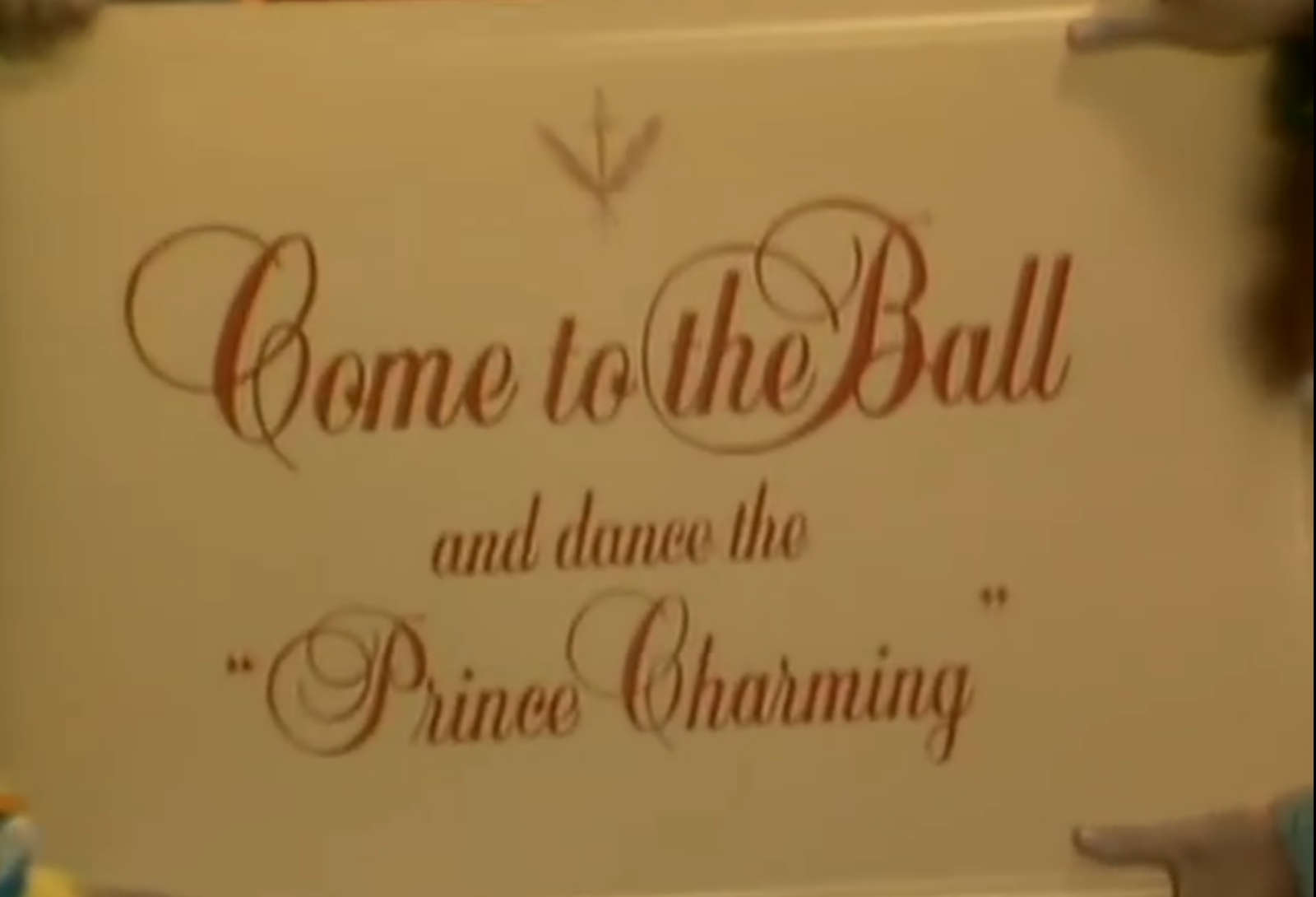 The majority of the camera shots used throughout the video are mid shots and long shots. For a video such as Prince Charming, this is particularly important because the mise en scene has such an essential role in the video. This gives the audience more time to absorb the costumes, narrative and iconic dancing during the video! There are also some close ups to show more intricate details in order to avoid confusion. For example, at one point there is a close up shot of the invitation to go to the ball and dance the "Prince Charming". This close up reinforces the narrative of Cinderella and informs the audience of what is happening in the video. It helps to avoid confusion but also offers a useful contribution to the overall narrative of the music video. Also, there are various tracking shots to show the characters moving around. When the two ugly stepsisters first enter, the camera tracks them walking across the set. This gives the audience more time to clarify who the characters are and to watch what they are doing as they walk into the room. It also gives the audience time to admire their rather prominent costumes.
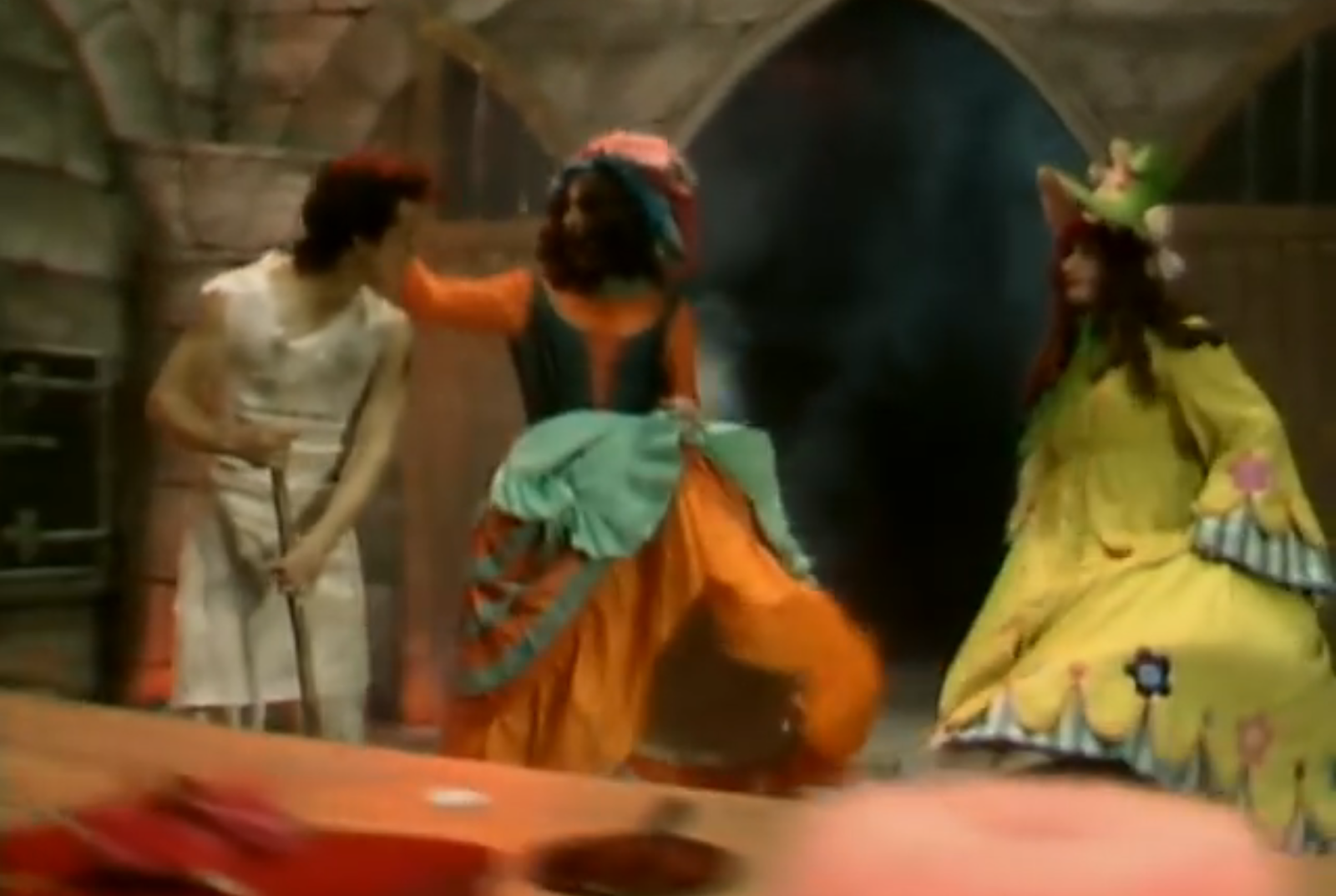 Of course, the sound is one of the most important aspects of the video. The song Prince Charming plays for the entirety of the video. Most of the video is lip synced, so the characters on the screen appear to be singing the song. This conveys a relationship between the song and the video.
Overall, I think that the iconicity of this music video is mainly due to the use of intertextuality, stars and comical atmosphere to the video. I love it!
The mise en scene used during this first scene makes the low budget particularly evident. The costumes, set and props look rather cheap. Despite this, the video is still successful because the budget is irrelevant when considering the success of this video; the strength of the stars, narrative and music reinforces the iconicity of the video. However, having grown up in the 21st century, where a higher production value is preferred, a high expense has become something of a necessity. This does not mean, however, that the target audience of the music video during its launch would have perceived it in the same way. For example, Split Enz's song I See Red (https://www.youtube.com/watch?v=vKj4upY1VYI) was released in 1978. They had a very simlar genre to Adam and the Ants' but had a somewhat smaller production budget. This serves as an example that at the time of release, the Price Charming music video would have looked particularly impressive to the audience, making it a more popular and iconic video. Bright colours are worn by the ugly step sisters (implying their happiness) whereas bland, white colours are worn by the man - until nearer the end, where he is revealed to be a more good looking fellah. The ladies love that.
The majority of the camera shots used throughout the video are mid shots and long shots. For a video such as Prince Charming, this is particularly important because the mise en scene has such an essential role in the video. This gives the audience more time to absorb the costumes, narrative and iconic dancing during the video! There are also some close ups to show more intricate details in order to avoid confusion. For example, at one point there is a close up shot of the invitation to go to the ball and dance the "Prince Charming". This close up reinforces the narrative of Cinderella and informs the audience of what is happening in the video. It helps to avoid confusion but also offers a useful contribution to the overall narrative of the music video. Also, there are various tracking shots to show the characters moving around. When the two ugly stepsisters first enter, the camera tracks them walking across the set. This gives the audience more time to clarify who the characters are and to watch what they are doing as they walk into the room. It also gives the audience time to admire their rather prominent costumes.Of course, the sound is one of the most important aspects of the video. The song Prince Charming plays for the entirety of the video. Most of the video is lip synced, so the characters on the screen appear to be singing the song. This conveys a relationship between the song and the video.Overall, I think that the iconicity of this music video is mainly due to the use of intertextuality, stars and comical atmosphere to the video. I love it!
Subscribe to:
Posts (Atom)